

.webp?language=en-US)

.webp?language=en-US)
Advertisement
Professional Practice Networks (PPNs)
Professional Practice Networks (PPNs) are communities of practice for ASLA members, providing a forum to make connections and facilitate peer-to-peer learning.

Professional Practice Networks Structure
Professional Practice Networks (PPNs) are a focused, connected, and valuable way for members to engage with the issues and communities that matter most to their careers.
Whether you are a seasoned principal, an emerging professional charting your first years in the field, or somewhere in between, the new PPNs are designed to give you a professional home within ASLA — a place to exchange ideas, sharpen your expertise, and shape the future of landscape architecture alongside peers who share your passion.
Join Your PPNs Today!
Professional Practice Networks Structure
ASLA's Professional Practice Networks (PPNs) are your professional home within ASLA: A place to exchange ideas, sharpen your expertise, and shape the future of landscape architecture alongside peers who share your passion.
Ten PPNs are organized under three Focus Areas:
- Career Development
- Practice & Technology
- Design
This makes it easier than ever to find your community. Active ASLA members can join up to three PPNs at no additional cost!
Career Development
Supporting professionals across small firms, public service, and leadership at every career stage.
Leadership and Mentorship PPN
This PPN focuses on the personal skills and resilience side of the profession. It's a space for landscape architects at every stage to share experiences, ask questions, and build the leadership capacity that strengthens firms and careers alike. If you're curious about office culture, navigating professional growth, or simply want a community where honest, supportive conversations happen — this is your network. Join to assess, discuss, and refine your professional trajectory alongside peers who understand the journey.

Small Practice PPN
Small Practice is unique because it focuses on the intersection of design and entrepreneurship. Unlike topic- or project-type PPNs, this group is about:
- Running a business, not just practicing design.
- Decision-making with limited staff and resources.
- Agility, independence, and direct client relationships. It’s one of the few spaces where conversations about fees, contracts, staffing, and growth strategies happen openly among peers facing the same scale of challenges.

Public Practice & Service PPN
For landscape architects working in the public sector — or those drawn to the unique challenges of designing for the public good — this network centers the vital intersection of practice and civic service. From municipal agencies to federal land management, public practice carries distinct responsibilities and rewards that deserve a dedicated community.

Practice & Technology Innovation
Exploring the tools, techniques, and materials that push the boundaries of how landscape architecture is practiced.
Technology in Practice PPN
What sets Technology in Practice apart is its role as ASLA’s hub for innovation in how we work, not just what we design. While other PPNs might focus on specific project types, this network looks across them all to explore how AI, smart infrastructure, data, and digital workflows are actively changing the day‑to‑day practice of landscape architecture and how we as a profession can stay at the forefront of technology.

Materials, Methods, Sourcing PPN
The Materials, Methods, Sourcing PPN is for landscape architects who care deeply about how great design actually gets built, coupled with how the decisions we make today affect performance, resilience, sustainability, cost, and craft over time. This PPN is uniquely positioned at the intersection of design, technical execution, material innovation, and construction realities. While other PPNs may focus on project types or design typologies, this network focuses on the systems, materials, detailing, sourcing strategies, and implementation methods that shape every landscape project regardless of scale or sector.

Design
Shaping inclusive, resilient places across every scale and community context.
Urban Environments PPN
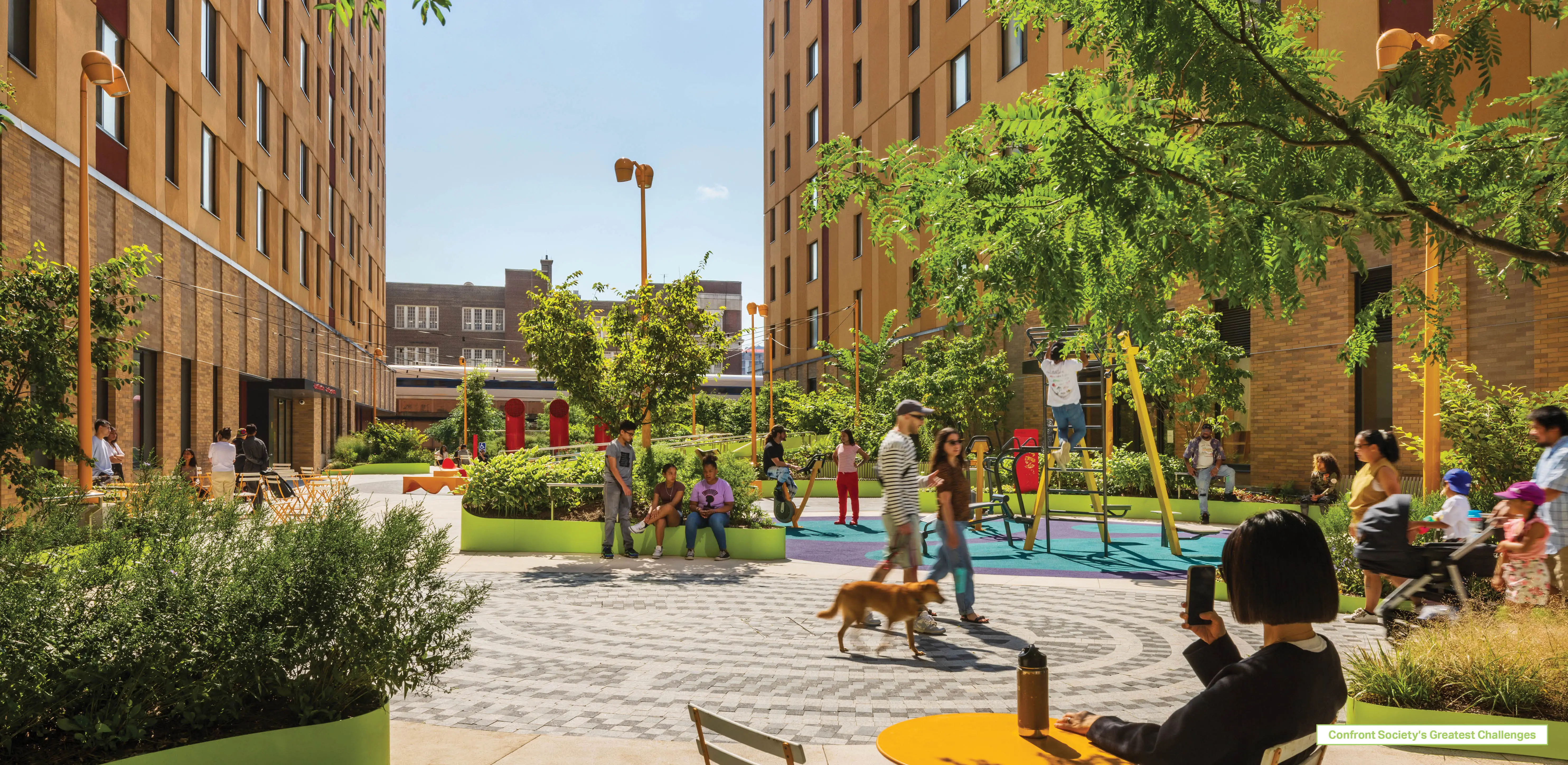
Compared with other practice areas, the Urban Environments PPN focuses on the places where many of the profession’s biggest questions converge:
- How do we retrofit existing cities for climate change?
- How do we design public spaces that are welcoming and accessible to many different users?
- How do we support density while still creating meaningful relationships between people and nature?
- How do we honor local culture and history while planning for growth and change?
This PPN creates a space to share how we navigate those questions in real projects, real communities, and real constraints. It recognizes that designing urban environments are not only about making places look better; it is about helping cities and towns function better for people, ecologies, and future generations.

Rural Practice PPN
The Rural Practice PPN serves as a forum for landscape architects and allied professionals in a wide range of roles engaged across the full spectrum of rural contexts. Rural places face challenges far more complex than the tools we’ve traditionally used to address them. Designing for thriving rural places requires approaches that can hold cultural, economic, ecology, environmental, and social complexity at once. The Rural Practice PPN draws from the full spectrum of rural knowledge—design, planning, policy, infrastructure, agriculture, housing, and community and economic development—to respond to the intertwined forces shaping rural people and places. We’re here to challenge assumptions, share emerging practices, and strengthen the profession’s understanding of rural resilience. If you’re motivated by the puzzle of why some communities thrive while others fade—and if you believe rural places deserve design that matches their depth—this PPN is the place to lead that change.

Institutional & Campus Environments PPN
The Institutional and Campus Environments PPN serves as a bridge between planning, design, operations, and institutional leadership. While many PPNs focus on specific practice areas or project types, our PPN examines the broader systems that influence how campuses function, evolve, and thrive. We recognize that successful institutional environments require collaboration across multiple disciplines and stakeholders. Our members explore how landscape architecture intersects with campus planning, mobility, sustainability, resilience, student experience, public space design, facilities management, and strategic decision-making. By connecting ideas from across the profession, the PPN provides a comprehensive perspective on creating places that support institutional missions and enrich the lives of their users. The Institutional and Campus Environments PPN creates a space where passionate professionals can come together to share knowledge, challenge assumptions, and advance the practice of landscape architecture and planning.

Parks, Outdoor Play & Outdoor Recreation
This PPN focuses on these heavily used spaces as critical public infrastructure, how long-term maintenance and management shapes the design long before construction, and the realities that parks and public facilities face with funding, operations and care in perpetuity. Looking at the design and construction from a macro perspective--from resource planning and infrastructure to maintenance and multi-generational use--is critical to the success of parks and recreation.

Master Planning & Development PPN
This network is for: Landscape architects engaged in land-use planning, large-scale transportation and infrastructure projects, master planning, international practice, and global hospitality and resort development.
Interested in becoming the Chair for the Master Planning & Development PPN? Please fill out this form, and a ASLA staff member will be in touch soon

Join Your PPNs Today!
Advertisement
Member-Led Affiliate Groups

Historic American Landscapes
The Historic American Landscapes Survey (HALS) documents historic landscapes in the United States and its territories to serve as tangible evidence of our nation’s heritage and development.

Education & Practice Working Group
The Education & Practice Working Group promotes collaboration and the exchange of ideas, issues, and emerging trends that advance the profession of landscape architecture while informing undergraduate and graduate education.

Visual / Scenic Stewardship Working Group
The Visual / Scenic Stewardship Working Group is a forum for landscape architects and environmental design, planning, and management professionals to share best professional practice and promote visual harmony between nature, culture, and all people.
PPN Leadership Guidelines
-
ASLA’s Professional Practice Networks (PPNs) provide peer-to-peer learning and networking events. These activities are led by each PPN’s Chair and Leadership Delegates.
-
With the support of other engaged PPN Leadership Delegates, PPN chairs are expected to:
- Schedule and lead PPN leadership team meetings with Leadership Delegates. If you can’t make a meeting, designate another PPN Leadership Delegates to fill in.
- With support of the PPN Leadership Delegates, plan the PPNs goals and deliverables for each term.
- With support of the PPN Leadership Delegates, plan virtual events for your PPN members that are peer-to-peer focused.
Leadership Term and Anticipated Time Commitment
Chairs can serve two consecutive years total.
Terms begin and end at the conclusion of the ASLA conference. Past chairs who would like to stay involved may do so as a PPN Leadership Delegates.
PPN Chairs should anticipate spending 5-7 hours per month on PPN activities.
-
Leadership Delegates serve as the PPN Chair's core support team — a cabinet of 5–7 members completing one-year terms. Unlike general PPN members who simply participate, Delegates are the drivers of the Chair's vision, taking ownership of projects, moderating sessions, and contributing to key deliverables. General members are welcome to plug into initiatives Delegates lead, agreeing only to the specific time commitment defined for that project. This structure keeps accountability with the Delegates while expanding the PPN's reach and creating meaningful engagement opportunities for the broader membership.
-
Technical
- Maintain PPN landing page on ASLA’s website, as well as support proposed additions/changes to each individual PPN page.
Logistical
- Schedule ASLA conference events.
- Keep Chairs abreast of important information, either from ASLA or other PPNs, that are pertinent and/or valuable for them to know.
Outreach & Coordination
- Send out communications drafted by PPN leaders via direct emails to PPN members.